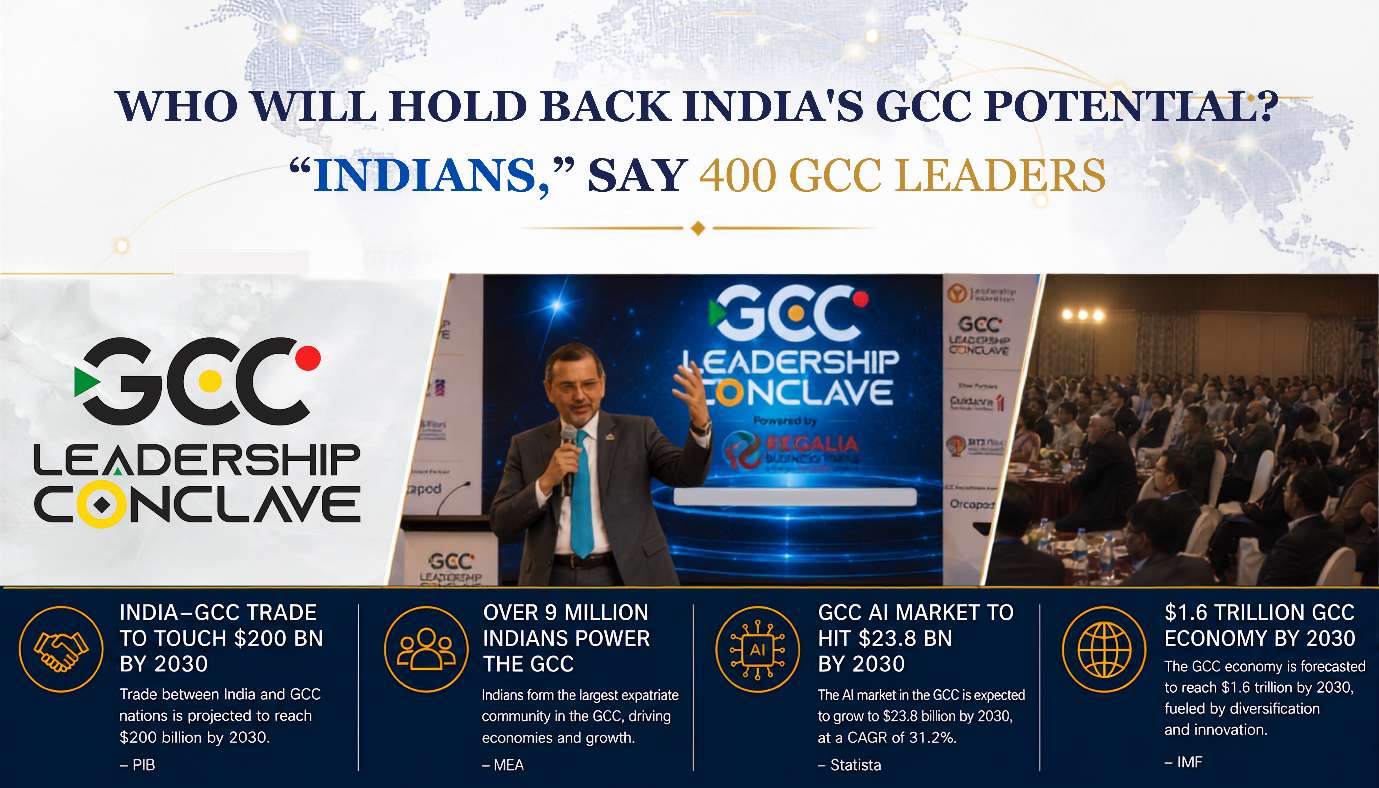
PUNE: A Leaders at the GCC Leadership Conclave in Pune debate whether India’s next frontier is no longer talent or technology, but the ability to create globally influential leaders.
Over the last two decades, Global Capability Centers (GCCs) have evolved from cost-arbitrage delivery hubs into sophisticated centers driving technology, analytics, engineering, finance, cyber security, customer experience, AI, and business transformation for some of the world’s largest corporations.
India’s GCC ecosystem continues to expand rapidly, attracting unprecedented investments and creating thousands of high-value jobs. Yet amidst the optimism surrounding this growth story, a recurring theme emerged during discussions at the GCC Leadership Conclave in Pune attended by more than 400 GCC leaders, business heads, CHROs, and senior executives.
The next challenge may not be talent.
It may not even be technology.
It may be readiness.
The Great GCC Debate
Throughout the conclave, one question repeatedly surfaced across panel discussions, executive conversations, and networking sessions:
Can India become the world’s leadership capital, or will it remain primarily the world’s talent capital?
Participants acknowledged that India has already demonstrated its ability to create exceptional technical talent.
The country continues to produce world-class engineers, analysts, technology professionals, finance experts, and business specialists. However, several leaders highlighted a gap that becomes increasingly visible as GCCs mature.
While Indian teams are often trusted to execute complex global mandates, strategic authority and enterprise-level decision-making frequently remain concentrated elsewhere.
Many participants pointed to challenges such as:
• Slow decision-making
• Excessive dependency on approvals
• Limited ownership culture
• Weak influence without formal authority
• Lack of cross-functional business exposure
• Inconsistent executive presence
• Limited global stakeholder engagement
• Difficulty navigating complex international business environments
One GCC leader summarized the challenge succinctly:
“India has already proven that it can deliver. The next question is whether India can influence.”
That observation resonated strongly across the audience.
Beyond Talent and Technology
Another major discussion point was the growing impact of Artificial Intelligence on the future of work. While most organizations are investing aggressively in AI, automation, and digital transformation, several speakers emphasized that technology alone will not determine future competitiveness. As AI takes over routine activities, organizations will increasingly differentiate themselves through capabilities that machines cannot easily replicate:
• Leadership
• Influence
• Judgment
• Trust-building
• Strategic thinking
• Relationship management
• Cross-cultural collaboration
Many attendees agreed that organizations may need to fundamentally rethink how they prepare future leaders.Traditional approaches focused primarily on technical capability may no longer be sufficient.
A Question That Sparked Reflection
Among the executive speakers at the conclave was Rahul Dev Pharasi, Chairman of the Defence Corporate Interface Council (DCIC), Curator of the Bharat Protocol Doctrine, and a long-time advocate of leadership readiness and global competitiveness.
During an interactive session on Global India Readiness and Talent Reinvention in the AI Era, Pharasi posed a question to the audience that quickly became one of the most discussed moments of the event.
“What will hold India back from realizing its full GCC potential?”
After a brief pause, voices from across the room responded:
“Indians.”
The response generated laughter.
But it also generated reflection.
According to many leaders present, the answer reflected a growing concern that India’s barriers are increasingly behavioural rather than technical.
• Reluctance to challenge authority.
• Fear of difficult conversations.
• Limited ownership.
• Execution without influence.
• Technical competence without business confidence.
• These themes surfaced repeatedly throughout the conclave.
India Has Mastered Talent Creation
Addressing the audience, Rahul Dev Pharasi argued that India does not face a talent problem.
“India has mastered talent creation. The next challenge is talent readiness.”
He suggested that future-ready professionals will require a broader set of capabilities than traditional organizations have historically emphasized.
These include:
• Executive presence
• Strategic communication
• Cross-cultural agility
• Influence without authority
• Stakeholder management
• Business storytelling
• Decision confidence
• Global leadership behaviours
According to Pharasi, organizations must move beyond preparing people merely to perform tasks and begin preparing them to operate confidently in complex global environments.
The Rise of Global India Readiness
A central concept discussed during the session was Global India Readiness, a framework that seeks to help professionals and organizations strengthen their ability to compete, collaborate, and lead on the global stage.
The premise is straightforward.
India’s future advantage will not come solely from technical excellence.
It will come from combining technical excellence with leadership credibility, business influence, global communication, and decision-making maturity.
The framework asks a powerful question:
What would it take for Indian professionals not just to participate in global business conversations but to lead them?
The Next Phase of GCC Evolution
Several leaders at the conclave agreed that the future of GCCs may no longer be defined by scale alone.
The next phase will be defined by authority.
The question is no longer:
“How many people work in Indian GCCs?”
The more important question may be:
“How many enterprise decisions are influenced from India?”
Similarly, the future discussion may not revolve around how many processes India manages.
Instead, it may focus on how much strategic responsibility, innovation ownership, and leadership influence resides within India.
A Defining Opportunity
The GCC story remains one of India’s greatest economic success stories.
Yet the discussions in Pune suggested that the next chapter may require a different kind of investment.
• Not merely in technology.
• Not merely in infrastructure.
• But in leadership readiness.
As organizations accelerate AI adoption and GCCs take on increasingly strategic responsibilities, the leaders who thrive will likely be those who combine technical expertise with influence, credibility, communication, and global confidence.
As Rahul Dev Pharasi observed during the session:
“The future does not belong to organizations that simply deploy AI. It belongs to organizations that develop globally ready leaders who know how to thrive alongside it.”
For India’s GCC ecosystem, that may be both the challenge and the opportunity of the coming decade.
Media Contact
pride@dcic.in